
DevOps
Operating dozens of sites across regions and stacks is competent engineering work, and the teams running them are competent. What's been hardest to do well is the work that grows in proportion to site count: bringing an on-call engineer up to speed when an alert fires, keeping the response playbooks current as the system changes, and seeing the patterns across incidents that hint at the next one.
We've built and operated the platform behind a large multinational NGO's digital presence in 100+ countries for years. One foundation, 100+ independent branch sites; we run the on-call, the releases, and the upgrade path. AI is part of how we operate at this scale: alerts arrive with the context already assembled, every code change gets a risk score before it ships, and the on-call playbooks stay current as the system changes. We start with one alert type, one risk score, or one playbook on real on-call shifts, then expand once it has earned trust. We won't ever let AI take action on its own; the engineer keeps the call, AI just compresses the time to it.
Capabilities
AI on operations only works when the platform underneath produces the data AI needs and stays predictable under the conditions AI runs in. We engineer that foundation first: one shared codebase across hundreds of sites, a structured record of every release and incident, monitoring data AI can actually read. The engineering economies are real (one upgrade cycle for 100+ sites); the data foundation is what everything else here builds on.
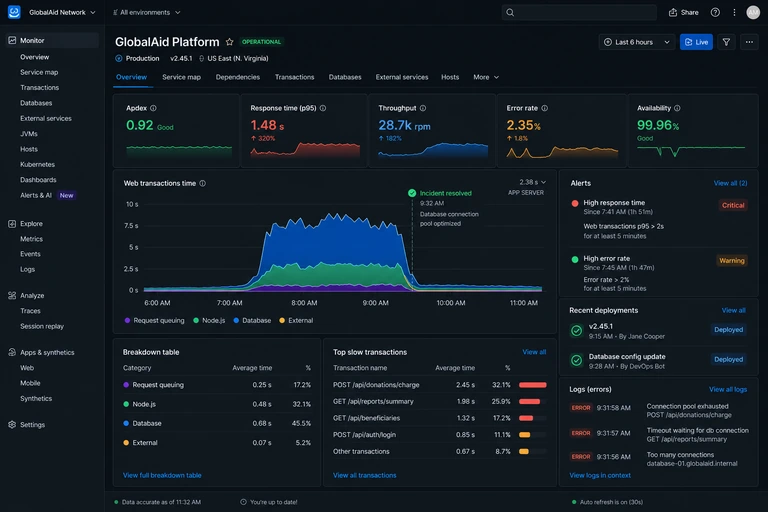
When an alert fires at 3am, the on-call engineer's first job is gathering context: recent releases, related logs, similar past incidents, what else might be affected. AI does that gathering ahead of time and presents the alert with the context already attached. The engineer makes the call; they just don't start from zero.
Each code change gets a risk score based on what it touches, how often those parts of the system have caused issues before, and how well the change is tested. Risky changes get extra review attention; routine changes ship faster. The score arrives with the reasoning attached, so engineers can accept it, override it, or refine it. Overrides feed back into how the model scores next time.
Playbooks drift the moment the system changes, and systems change every week. AI reads the incident history and the system layout together, generating playbook updates as the system changes. When reality drifts from the playbook, you find out before the next incident, not during it.
Authorized engineers can connect their AI client to the platform through a Model Context Protocol (MCP) endpoint, scoped by role and audited. Logs, releases, incident history, and playbooks become available to query in plain language from the AI client they already use, instead of jumping across half a dozen dashboards. The data stays inside the partner's perimeter; the conversation comes to it.