
Editorial review
Communications teams already review what they publish. The cap is volume: when hundreds of authors across regions and languages publish independently, headquarters review is a sampling exercise. What's next is continuous coverage across every draft, with editors spending their time on the parts the model can't handle.
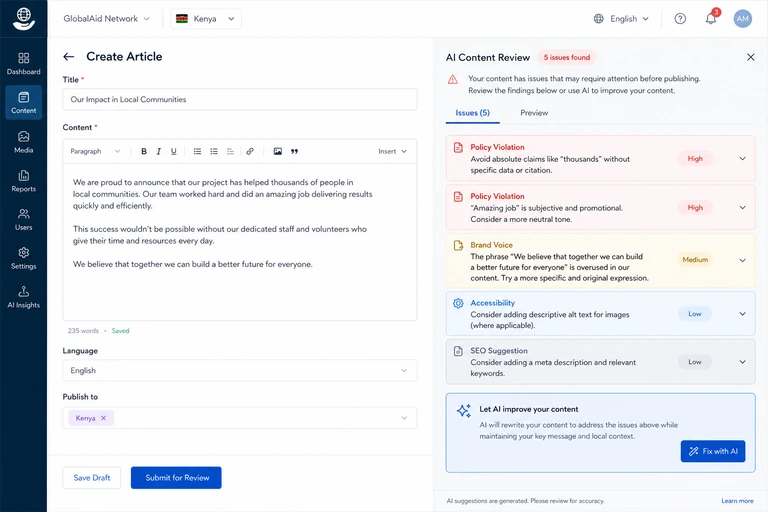
We build the editorial-review layer that sits between draft and publish in your content workflow. Each draft is checked against the policies that matter to your organization: factual claims that need a citation, language that drifts off-brand, accessibility gaps, basic SEO hygiene. Issues come back in seconds, ranked by severity, with a one-click rewrite for the cases the model can handle confidently. We won't replace editorial judgment on calls that depend on local context, sensitivity, or audience nuance; those still go to a human editor, with the routine issues already handled. The smallest useful version ships in weeks: one policy area, one site, one language, and grows from there.
Capabilities
Communications policy lives in a style guide and a few people's heads. AI brings it into the editor: factual claims that need a citation, promotional adjectives that pull a piece off-tone, regulatory language that needs specific phrasing. The author sees the flag at the moment they wrote the line, not in a review meeting two weeks later.
Every organization has a voice; what's hard is keeping it consistent when hundreds of authors write at once. AI compares each draft to the canonical voice (drawn from your published back-catalog), flagging stale phrases, off-brand register, and formulations that have been over-used across the network. Authors keep their style; the rare drift becomes visible.
Accessibility and SEO are easy to forget at draft time and expensive to retrofit after publish. AI checks both as the author writes: missing alt text, headings out of order, meta description absent, keywords thin. The author fixes them in the same screen, before the draft reaches an editor.
Where the issue has a clear right answer (a softer adjective, a more specific phrase, a missing meta description), AI proposes a rewrite the author can accept, edit, or reject. The hard editorial calls (sensitive language, local context, audience-specific framing) go to a human editor with the routine issues already cleared.